 Deck Busters
Deck Busters › Blog › Pressure-Treated vs. Cedar vs. Composite Decking Costs in Simcoe County
← All articlesPressure-Treated vs. Cedar vs. Composite Decking Costs in Simcoe County
Key takeaways
- Pressure-treated decking has the lowest upfront planning cost at $45–$65 per square foot installed; cedar is $55–$80, and composite is $65–$95 under the same basic scope.
- A standard 12×16-foot deck is budgeted at $8,640–$12,480 in pressure-treated lumber, $10,560–$15,360 in cedar, or $12,480–$18,240 in composite.
- The board material is only one part of total cost. Height, stairs, railings, footings, access, demolition, and grading can have a larger effect on the final quote.
- Pressure-treated lumber suits low upfront budgets, cedar suits homeowners seeking authentic wood character, and composite suits owners who want less routine refinishing.
- Compare contractor proposals only after matching dimensions, framing, footings, railing length, stairs, site work, permit responsibility, taxes, and product specifications.
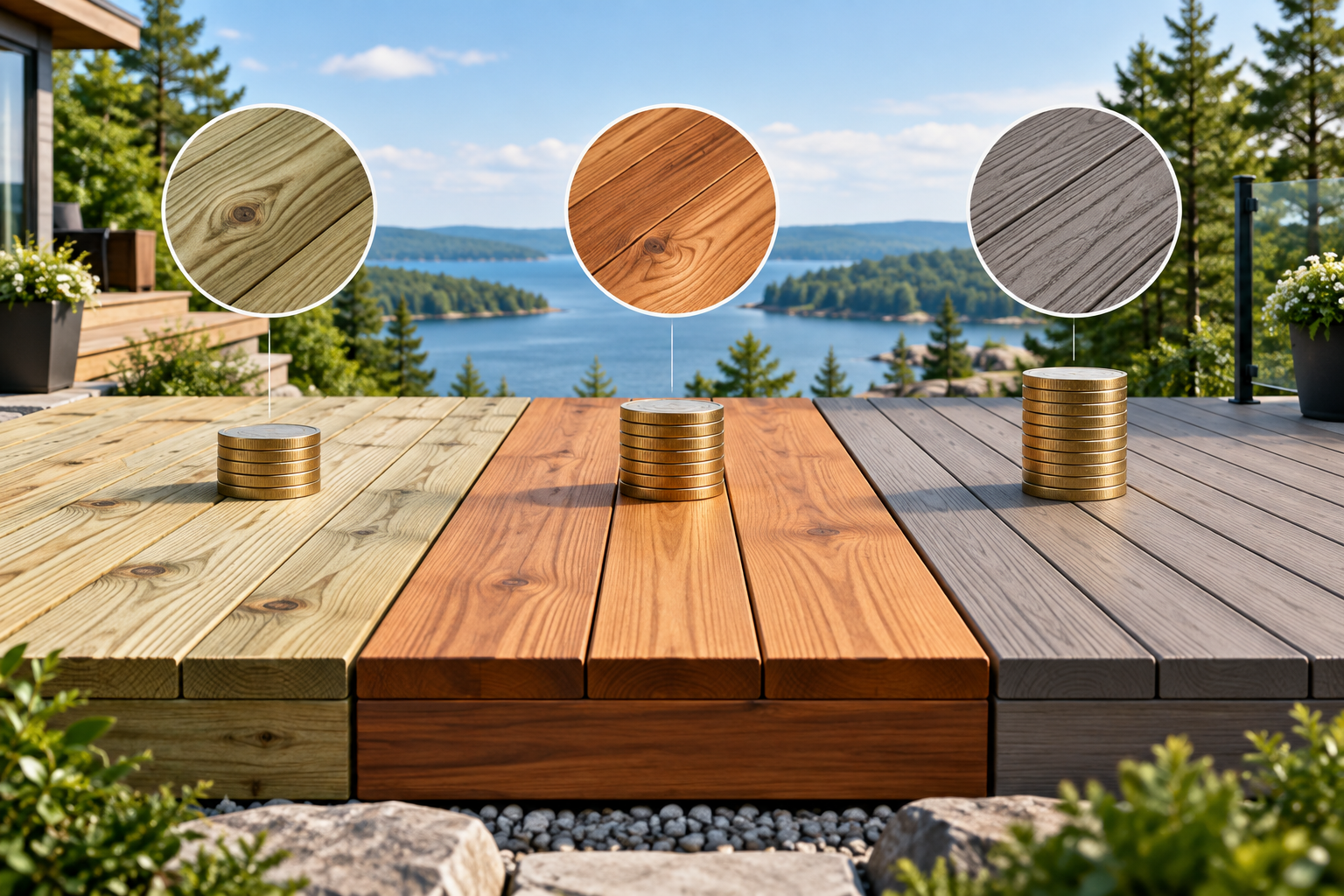
Pressure-treated lumber is usually the lowest-cost deck surface in Simcoe County, cedar costs more for its natural appearance, and composite costs the most upfront but avoids routine staining and sealing. For a standard 12×16-foot deck, realistic planning budgets are approximately $8,640–$12,480 for pressure-treated, $10,560–$15,360 for cedar, and $12,480–$18,240 for composite.
Simcoe County deck-cost comparison at a glance
The table below is a like-for-like planning model, not a published contractor rate card. It assumes a simple rectangular residential deck with standard pressure-treated framing, typical footings, a basic railing package, one straightforward stair run where required, and normal site access.
| Deck material | Installed planning range | 12×16 deck (192 sq. ft.) | 16×20 deck (320 sq. ft.) | Best fit |
|---|---|---|---|---|
| Pressure-treated lumber | $45–$65 per sq. ft. | $8,640–$12,480 | $14,400–$20,800 | Lowest upfront cost |
| Cedar | $55–$80 per sq. ft. | $10,560–$15,360 | $17,600–$25,600 | Premium natural-wood look |
| Composite | $65–$95 per sq. ft. | $12,480–$18,240 | $20,800–$30,400 | Lower routine maintenance |
These figures include more than deck boards. A finished deck quote normally includes framing, beams, posts, footings, hardware, railings, fasteners, labour, and contractor overhead. That is why installed prices are much higher than the retail price of decking boards alone.
> Important: These are planning allowances for basic decks in communities such as Barrie, Innisfil, Orillia, Bradford West Gwillimbury, Springwater, Wasaga Beach, and Collingwood. Sloped lots, high decks, poor access, premium railings, demolition, and custom layouts can move the final quote substantially.
A transparent 12×16-foot budget example
A 12×16-foot deck has a surface area of 192 square feet. However, contractors do not buy exactly 192 square feet of decking. They allow for cut-offs, picture framing, damaged boards, stair treads, and layout waste.
For budgeting, a homeowner can use a 5% to 10% material allowance. At 10%, the project requires roughly 211 square feet of decking material before considering fascia and stair components.
Here is how the installed comparison works:
- Pressure-treated: 192 sq. ft. × $45–$65 = $8,640–$12,480
- Cedar: 192 sq. ft. × $55–$80 = $10,560–$15,360
- Composite: 192 sq. ft. × $65–$95 = $12,480–$18,240
The material choice does not change every part of the budget. Footings, beams, joists, posts, permits, stairs, and railings can represent a large share of total cost regardless of whether the walking surface is wood or composite. Composite raises the quote principally through board cost, hidden fasteners, fascia, colour-matched trim, and sometimes tighter framing requirements specified by the manufacturer.
What is included—and excluded—in these ranges?
To compare materials fairly, the ranges above assume the same basic construction scope:
- Rectangular deck footprint
- Standard pressure-treated structural framing
- Typical footings and post installation
- Standard guard/railing system
- Basic deck stairs where needed
- Conventional board layout and fastening
- Reasonable access for workers and material delivery
They do not include major excavation, retaining walls, drainage correction, extensive grading, hot-tub structural design, screened rooms, pergolas, integrated lighting, privacy walls, premium glass railings, cable rails, curved boards, multiple landings, or substantial demolition.
Those exclusions matter. A homeowner comparing a $14,000 composite quote to a $12,000 pressure-treated quote should confirm that both prices include the same railing length, stairs, footings, demolition, permit work, and HST treatment before deciding that one material is only $2,000 more expensive.
Pressure-treated decking: lowest initial price
Pressure-treated lumber is the conventional value choice for Simcoe County decks. It is widely available, familiar to most framing and deck crews, and can be cut, repaired, stained, or replaced using standard tools and methods.
The preservative treatment is intended to help protect wood used in exterior applications from decay and insect damage. Wood Preservation Canada explains that treated wood is commonly used in outdoor residential projects because of its durability in ground-contact and above-ground applications when the correct product is selected and installed properly (Wood Preservation Canada).
Pressure-treated cost profile
For a basic deck, pressure-treated lumber generally offers:
- The lowest installed starting point: $45–$65 per square foot in this planning comparison
- Straightforward replacement of a damaged or split board
- Many stain and paint colour options
- Easy compatibility with standard framing and railing systems
- Broad availability when a repair is needed years later
The trade-off is maintenance. Pressure-treated boards weather, fade, check, and can develop splinters over time. Homeowners who want to preserve colour and reduce weathering typically clean and apply a suitable water-repellent stain or sealer periodically. The timing depends on sun exposure, board condition, drainage, foot traffic, and the coating product—not a fixed annual rule.
Best use case for pressure-treated lumber
Choose pressure-treated decking when the priority is a functional, affordable outdoor space and you are comfortable with periodic cleaning and refinishing. It is often the sensible choice for rental properties, first decks, large utility decks, or homeowners who would rather spend budget on stairs, landscaping, or better railings than premium deck boards.
Cedar decking: natural character at a mid-range price
Cedar costs more than pressure-treated lumber because homeowners are paying for a naturally attractive species with visible grain, warm colour, and a lighter-weight feel underfoot. It is a good fit when authentic wood appearance matters more than minimizing the initial budget.
The Western Red Cedar Lumber Association notes that western red cedar is valued in outdoor applications for its natural durability and dimensional stability characteristics, though it still requires appropriate detailing and maintenance for exterior use (Western Red Cedar Lumber Association).
Cedar cost profile
Under the same comparison scope, cedar is budgeted at $55–$80 per square foot installed. For a 12×16 deck, that creates a project allowance of $10,560–$15,360.
Cedar’s advantages include:
- Distinctive grain and natural colour variation
- A more premium wood appearance than standard pressure-treated boards
- The option to let the surface weather to grey or maintain its original tone with finish products
- Individual board replacement when damage occurs
- Lower initial cost than many composite systems
Like pressure-treated wood, cedar needs regular care if appearance is important. It can fade, weather, check, and collect mildew or algae in shaded, damp locations. It is not a maintenance-free material.
Best use case for cedar
Cedar makes sense for homeowners who want real wood rather than a wood-look product, especially on visible backyard decks connected to landscaped gardens, cottages, or traditional homes. It is a design-led choice: the value is visual warmth and natural material character, not reduced upkeep.
Composite decking: highest upfront cost, less finishing work
Composite decking is the highest-cost option in this comparison at $65–$95 per square foot installed, or $12,480–$18,240 for a 12×16 deck. The premium comes from the boards themselves, concealed fastener systems, matching fascia, trim, and product-specific installation details.
Composite does not require the routine staining or sealing associated with wood decking. Manufacturers still require cleaning and care. For example, Trex recommends periodic cleaning to remove dirt, debris, food spills, and organic material, particularly in shaded or wet areas (Trex Care and Cleaning Guide).
Composite cost profile
Composite is often the strongest choice for homeowners who value predictable appearance and less seasonal maintenance. Common benefits include:
- No routine staining or sealing
- Consistent colour and board profile
- Lower ordinary splinter risk than weathered wood
- Concealed fastening options for a cleaner finished surface
- Product warranties that may cover specific manufacturing defects, staining, fading, or structural performance depending on the line
However, “low maintenance” does not mean “no maintenance.” Leaves, pollen, grease, mud, algae, and snow melt can still make a deck dirty or slippery. Dark colours can also feel noticeably hotter in direct sun. Before choosing a colour, request full-size samples and place them outdoors in the intended exposure—not just under showroom lighting.
Best use case for composite
Composite is often worth the premium for homeowners planning to stay in the home for many years, people who do not want recurring stain-and-seal projects, and households that prioritize a uniform finish. It can also be appealing for busy families, waterfront properties, and cottages where maintenance time is limited.
The costs that can change a Simcoe County deck quote most
Deck-board material matters, but site and design conditions often have a larger effect on the final price. These are the most important quote drivers to identify before comparing contractors.
Deck height and guard requirements
A low platform deck is generally simpler than an elevated deck. Once a deck is high enough to require guards, the project needs more posts, railing, hardware, labour, and inspection attention. Ontario’s building requirements address guards, stairs, structural loads, and foundation design; consult the current Ontario Building Code and local building department before finalizing a design (Ontario Building Code, O. Reg. 332/12).
Railings and stairs
Railing upgrades can consume a large part of the difference between two quotes. Basic wood railing, aluminum pickets, black aluminum systems, glass panels, and cable railings are not interchangeable price points. Likewise, a single narrow stair run is very different from wide stairs, a landing, multiple levels, or integrated lighting.
Footings, soil, and access
A backyard with open access is easier to build than one where crews must carry lumber through a finished home, narrow side yard, or steep slope. Footing depth, soil conditions, existing landscaping, buried services, and frost protection requirements also affect labour and equipment needs.
Layout complexity
A 16×12 rectangle is usually efficient. Angled corners, curved borders, diagonal board layouts, herringbone patterns, picture framing, benches, planters, privacy screens, and multi-level transitions all increase cutting, waste, framing, and labour.
How to compare quotes fairly
Ask every contractor to price the same written scope. A useful quote checklist should identify:
1. Finished deck dimensions and height above grade
2. Decking brand, product line, board profile, and colour
3. Framing species, joist spacing, beam size, and hardware
4. Footing type, number, and installation depth
5. Railing type and linear footage
6. Stair width, riser count, landing size, and handrails
7. Fascia, skirting, picture framing, and concealed fasteners
8. Demolition, disposal, excavation, grading, and restoration
9. Permit drawings, engineering, inspections, and who is responsible
10. HST, payment schedule, warranty, and change-order process
For composite decks, ask whether the joist spacing follows the selected manufacturer’s installation guide. Some board profiles, diagonal layouts, and stair applications require closer spacing than a straightforward wood-deck layout. Trex publishes installation guidance and product-specific documentation for its decking systems (Trex Installation Resources).
Bottom-line recommendation
| If your main priority is… | Best material choice | Why |
|---|---|---|
| Lowest initial cost | Pressure-treated lumber | Lowest installed planning range and easy repairs |
| Authentic natural wood appearance | Cedar | Visible grain, warm tone, and premium character |
| Minimal routine finishing work | Composite | No regular staining or sealing |
| A large deck on a controlled budget | Pressure-treated lumber | Lets more of the budget go to structure, stairs, or landscaping |
| A long-term, consistent-looking surface | Composite | Higher entry cost in exchange for reduced upkeep |
| A premium wood deck without composite pricing | Cedar | Natural material at a middle price point |
For most budget-conscious Simcoe County homeowners, pressure-treated lumber remains the practical starting point. Cedar is the better choice when genuine wood appearance is the priority. Composite is usually the strongest fit when avoiding regular refinishing is worth paying more at installation.
FAQ
How much does a 12×16 deck cost in Simcoe County?
Using the same basic scope, a 12×16-foot deck is approximately $8,640–$12,480 in pressure-treated lumber, $10,560–$15,360 in cedar, and $12,480–$18,240 in composite. Elevated decks, premium railings, difficult access, and site work can increase these allowances.
Is composite decking cheaper than wood over time?
Composite is not cheaper to install. It can reduce long-term maintenance spending because it does not need routine staining or sealing. Whether it is less expensive over the full ownership period depends on the deck size, selected composite line, labour costs for wood refinishing, and how consistently the owner maintains a wood deck.
Is cedar more expensive than pressure-treated decking?
Yes. In this Simcoe County planning comparison, cedar is estimated at $55–$80 per square foot installed, compared with $45–$65 for pressure-treated lumber. Cedar’s added cost reflects its natural appearance and species characteristics.
What is the most expensive part of building a deck?
On simple low decks, structure and labour are major costs alongside decking boards. On elevated or custom decks, railings, stairs, footings, access constraints, demolition, grading, and design complexity can add more than the difference between pressure-treated and composite boards.
Does composite decking get hot in the sun?
Yes. Like other exterior surfaces, composite warms in direct sunlight, and darker colours generally absorb more heat. Review full-size samples at the site before selecting a dark board for an unshaded south- or west-facing deck.
References
- https://ddexteriorfinishing.ca/blog/deck-building-cost-ontario
- https://buildersontario.com/cost-to-build-a-deck-ontario
- https://www.msdcon.ca/blog/deck-cost-ontario-2026
- https://prosfix.ca/services/decks
- https://www.homedepot.ca/en/home/categories/building-materials/decking/deck-boards/f/pressure-treated/5-4-x-6/wbc-44wo-3dh1
- https://www.homedepot.ca/en/home/categories/building-materials/decking/deck-boards/f/square/5-4-x-6/wbc-2zgf-3dh1
FAQ
How much does a 12×16 deck cost in Simcoe County?
For a basic 192-square-foot deck, plan approximately $8,640–$12,480 for pressure-treated lumber, $10,560–$15,360 for cedar, and $12,480–$18,240 for composite. These figures assume standard framing, footings, basic railings, and normal site access.
Is composite decking cheaper than wood over time?
Composite costs more to install but can reduce maintenance costs because it does not require routine staining or sealing. The long-term result depends on the selected products, ownership period, and how often a wood deck is refinished.
Is cedar more expensive than pressure-treated decking?
Yes. Cedar is estimated at $55–$80 per square foot installed in this comparison, versus $45–$65 for pressure-treated lumber. Cedar commands a premium for natural grain and appearance.
What upgrades add the most to a deck quote?
Deck height, guardrails, stairs, premium railing systems, demolition, excavation, grading, difficult access, multiple levels, and complex board patterns can materially increase total project cost.
Does composite decking get hot in the sun?
Yes. Composite decking can become hot in direct sunlight, particularly in dark colours. Homeowners should test full-size samples outdoors at their property before selecting a colour.